Showing posts with label CBS Sunday Morning. Show all posts

Wednesday, February 19, 2014

Modern Mermaids


I think I may have mentioned this before, but CBS Sunday Morning has become one of my favorite weekend rituals. The show is clearly geared towards an older, early-rising generation with its bow-tied host and profiles on Danny Kaye and the origin of the steamboat. But more often than not I've seen some features that have actually brought tears to my eyes and others that have even taught me something new. 

Two weeks ago they had a super interesting segment on female Japanese free divers known as the ama. These women plunge to depths of up to 80 feet in search of seafood and pearls without the use of oxygen tanks. It is mainly a female profession as it is thought that women are better insulated than men when it comes to enduring the colder temperatures of deep waters because of how their body fat is distributed. The divers used to work topless, wearing only a loincloth, but now most of them zip up in more modest wet suits. It is a 2000 year old tradition that is strictly regulated and many of the divers are now older women, some practicing well into their 80s and 90s. The profession is now dying out somewhat because of climate change and overfishing as well as the attraction of more modern careers. Of course as soon as the segment was over I dug into the internet looking for more information and found these beautiful photos from the 1950s: 


photo by Yoshiyuki Iwase

Harvesting Seaweed, 1956

Taken Aback, 1950

I also discovered a Vice interview with photographer Nina Poppe who published Ama, a book featuring her photographs of a present day ama community from Ise-Shima


- Cathleen 


[Images 1-3 by Yoshiyuki Iwase via lomography.com
images 4-6 by Nina Poppe via Vice.com

Wednesday, February 1, 2012

The Amazing Automaton!


Even though it makes me feel like a blue haired retiree to admit it, CBS Sunday Morning has become one of the best parts of my weekends spent at home. Brewing a tall mug of Vanilla Cinnamon tea and snuggling down on the couch to see what sweet special interest story good ol' Charles Osgood has got on the docket always makes me feel like there is truly no better way to start my week. And this last episode was no exception. They did a great piece on the automaton that inspired Brian Selznick's book The Invention of Hugo Cabret that inspired Martin Scorsese's film Hugo. 


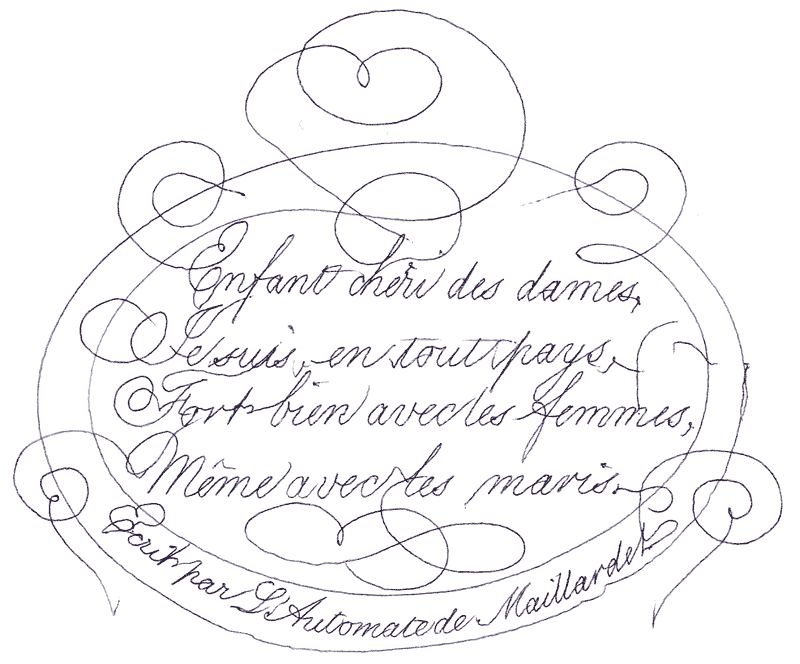
"The Draughtsman-Writer" as it is known today, originally arrived at Philadelphia's Franklin Institute in 1928 as a jumbled pile of broken brass pieces. Once it was assembled and put into working order again, the spring-activated automaton drew four pictures and wrote three poems (two in French, one in English), qualifying it as having the largest "memory" in automaton history. It was when the machine first penned one of its poems that it revealed its maker to be Henri Maillardet, a Swiss clockmaker and mechanic, finally leading researchers to determine that it was built in 1805.

One of the poems that reads across the bottom: 
"written by the automaton of Maillardet"

One of the automaton's cherubic drawings

While falling down the virtual rabbit hole in my research, I discovered an even more interesting apparatus that was made by Jacques de Vaucanson in 1739. Canard DigĂ©rateur, or Digesting Duck, was billed (ha!) as a mechanical duck that could eat grain, drink water, metabolize, and defecate. Such a scientific wonder! 


What actually happened, however, was that the food was collected in a secret chamber inside while pre-stored duck poop would be ejected out the other end---that's right: no actual digestion took place. My question though is whose job was it to collect all the poop and jam it up the robot duck's butt until it was time to squirt it out again? Not it!

There was another phony automaton peddled around that time created by one Wolfgang von Kempelen. Known as "The Turk," it was a chess-playing "machine" that was actually operated by a chess master who sat hidden inside. It was designed in such a way that the man inside could slide out of view whenever the demonstrator opened any door to show the audience the working parts within. Sounds like quite the small and powerful Oz. 


Clearly the most impressive automatons are the ones that actually do what they say they're going to do, without any bait-and-switches or strings attached. But I'm not sure they make for as interesting a story.


- Cathleen


[Images courtesy of Cubic MuseThe Franklin Institute, and Wikipedia]
Related Posts Plugin for WordPress, Blogger...